Good news, everyone: it's Family Game Night!
[ominously] Choose and perish.

[rubs hands together, blows into them] Whoo! Cold enough for ya?
We're deep in the throes of winter right now, with Arctic temperatures gripping much of the country. It's tough times if you have anything you need to do outside–at this point you're just going to have to pretend you planned to leave the Christmas lights up all year–but things get even tougher when you've got kids under your roof. Mine have been bouncing off the walls this week, and if it were a little bit warmer, I'd simply tell them to go outside and play. When temperatures dip into the single digits, though, that's a much harder sell.
Inevitably, someone is going to make a suggestion: why don't we play a game?
Oftentimes I'm the one making the proposal, under the pretense that "well, it's better than screens!" This is a lie, and everyone knows it. (Screens are great.) Still, as the parent in this scenario, I am obligated to perpetuate the lie. Other times, it's my kids making the suggestion, typically after the screen-time limits I've imposed on their devices out of the same mistaken sense of obligation are reached.
However it happens, we then find ourselves at a critical moment.
We have a shelf full of board and/or card games, each purchased as a starry-eyed, optimistic investment in a wholesome, constructive and screen-free family night. They range wildly in theme, difficulty, and style of play, and we must ask:
What kind of argument do we want to have tonight?
Let's review our options.
Monopoly
It's one of the most popular board games of all time, a beloved American icon that's spawned countless spin-off versions. On our shelf alone, we have Monopoly, Monopoly Travel World Tour, and Super Mario Bros. Monopoly, and if the city you live in doesn't have a version that replaces Boardwalk and Park Place with local landmarks, then your tourism board isn't doing their job.
It's also a merciless slog of a game, one that can take hours to complete as you struggle paycheck-to-paycheck, desperately trying to stay afloat under the crushing rents imposed by a once-loving child whom the game has transformed into a brutal slumlord through the same power-corrupting forces that defined the Stanford Prison Experiment.
Choosing to play Monopoly is like choosing to invade Afghanistan: no one has ever done it with a realistic endgame in mind.
Sorry!
Let's try something simpler, then.
Sorry! is simple, quick and straightforward; easy enough to be learned by anyone, and easy enough to be won by anyone. Sounds good, right?
Practically speaking, this means that the one person who didn't want to play is going to win, and the person who did want to play is going to accuse them of cheating. Neither of them will, in fact, apologize.
Life
Life is a classic, breezy board game that teaches some correct life lessons (pursuing a creative career will cost you money) and some wildly incorrect ones (having a baby will make you money).
It is right roughly half the time, which is on par with my own parenting.
Ticket to Ride
The first 21st-century addition to this list is a clever, fun and challenging game wherein players take on the role of would-be railroad barons, competing to extend their routes across a map of the United States (or various other locales, in newer editions). It takes a good bit of strategy, patience, and the occasional sharp elbow, and the winner often isn't clear until the very end.
We have never played this game once without someone crying or screaming.
Recently, I have attempted to address this conflict by introducing a bit of levity; I now punctuate every move I make in the game by imitating the fictional railroad tycoon George Russell from HBO's The Gilded Age, boasting that "J.P. Morgan and I have other plans."
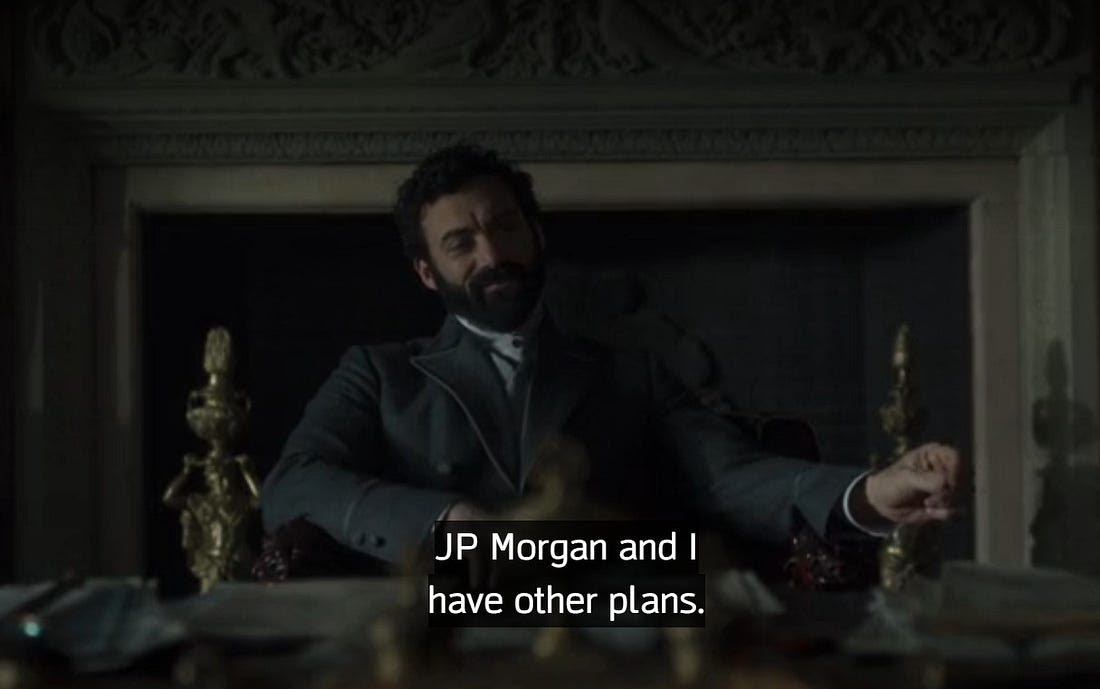
This strategy has been wildly successful, insofar as no one wants to play Ticket To Ride with me anymore.
Clue
In my opinion, the classic detective game is too focused on suspects and not enough on motive. Sure, Professor Plum beat me to death with a candlestick in the parlor, but why did he do that?
(It was because I wouldn't stop doing the George Russell voice, wasn't it?)
Trivial Pursuit
I think it's important for my children to have a broad base of knowledge, and that's why I enjoy Trivial Pursuit. The venerable quiz game requires you to answer questions in five easy categories (Geography, History, Arts & Literature, Science & Nature, Sports & Leisure) and one category that will be staggeringly out of line with the age of the players no matter the edition you are playing nor the age of the players (Entertainment).
"Daaaaaad, how am I supposed to know that?!?!"
"I don't know, but you expected me to know how magnets work at 6:00am last Saturday, so answer the question: who won the Tony for Best Actress in a Musical in 1990?"
Scrabble
Like many things in life, Scrabble purports to reward intelligence, where in reality it rewards obsessive weirdos who know all the secret little tricks to getting ahead.
I know this, because I am very, very good at Scrabble.
My family also knows this, because they will agree to play me in Scrabble once every three to five years, nodding politely and patronizingly as I run up a 200-point margin of victory on the strength of words I do not know the definitions to.
"What's QI, Dad?"
"It's 33 points on that Triple Word Score, mark it down."
Chess
The granddaddy of them all, the centuries-old game is a welcome salve after Scrabble, as the children can be reassured that their father is not actually that smart after all. I understand the rules of chess much in the way that I understand how to fly an airplane: I know what moves are possible, but I do not know how to sequence them in a way that will be anything but catastrophic.
Several years ago, my son got a book called How To Beat Your Dad in Chess, and while it's a nice summary of the game for younger readers, it was almost entirely unnecessary for the Dad that he has.
Candyland/Chutes and Ladders
Both of these games are highly accessible to young children, as they require no strategy to win, only sheer luck. This should be an asset, but any parent who's agreed to play "one more game" before bedtime knows the strategic value in taking a well-timed dive, and that's much harder to pull off when you're leaving things up to fate.
Make no mistake: you, the adult, are going to win, and that's going to be a problem for you.
Battleship
In fact, let's game out that scenario: it's now fifteen minutes past bedtime, you're exhausted, and you've got a child who is furious that they've just lost at Candyland.
What's your best recourse? Why, a strategic naval defeat, of course!
Maybe they won't be into the idea of military action on the high seas at first, but that'll change as soon as they start scoring hits–and boy, wouldn't you know, they're scoring a bunch of them! In fact, they just sank your battleship!
(No, no need to look. It's already at the bottom of the ocean.)
You can wrap this conflict up in a matter of minutes, nobly sacrificing your fleet in service of a lasting household peace. And who knows? Maybe it'll spark some new interests for them.
"Dad, can we play Battleship again tomorrow night?"
"Actually, I was thinking we'd watch a movie instead. It's called Master and Commander: The Far Side of the World, and I think it's right up your alley..."
–Scott Hines (@actioncookbook)
What's your favorite game to get into a family argument about?
Enjoy today's newsletter? There's more where that came from, but the very best that the ACBN has to offer (my jam-packed Friday newsletters) are for paying subscribers only. Upgrade your subscription today!